When you hire a company to build something, you end up telling it things. What you are launching and when. What the last agency got wrong. Numbers that are not public yet. Names of people who do not know they are being discussed.
Almost nobody asks where that conversation goes. It goes wherever the free tool was nearest.
We built our own room instead. Here is what that means for the work we do with you, and what it cost to do.
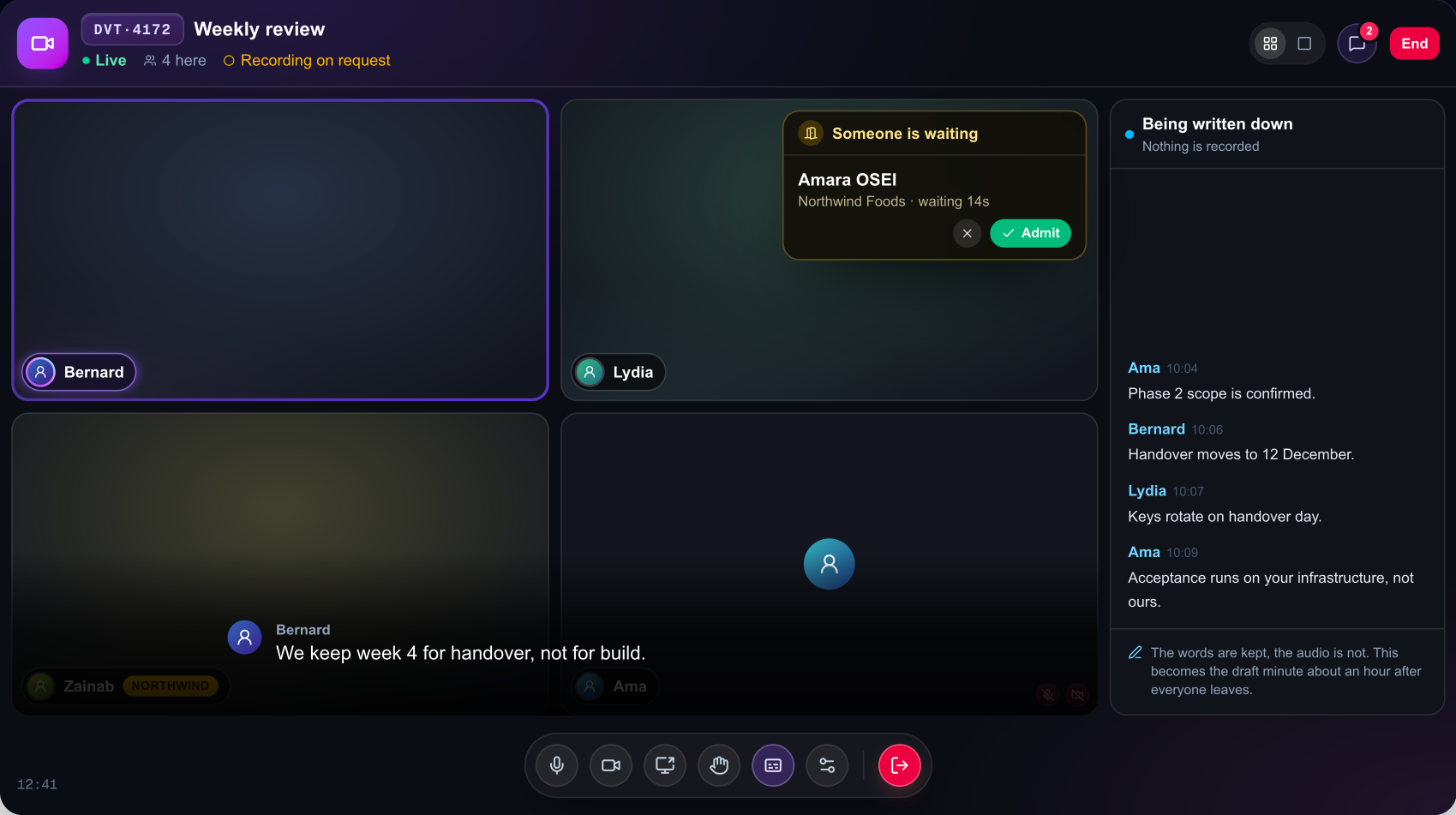
The decisions somebody has already made for you
Some things get decided before you join a call, whichever tool you use. Who can get in. What is kept, and for how long. Whether a transcript exists afterwards, and who can search it.
On a tool you did not build, those are defaults — chosen sensibly enough, for millions of calls of every kind, by people who have never heard of your project. Most of them are perfectly reasonable. They are simply not yours.
Three of them we wanted to make ourselves.
One: the provider never learns who is in the room
When somebody joins a call with us, the only thing our media provider is ever told about them is an opaque id:
4f2c91ae-7d3a-4e61-9c88-0b5a1e77d204No name. No email. No company. The token carries that id, one room, what the holder may do, and an expiry — nothing else. Real names appear on the tiles because our own system supplies them separately, over a connection we control.
Same thing on screen. Nothing about you in transit.
The usual shape of a privacy policy is a promise to redact personal data after it has been stored. Never sending it is a stronger thing, and it is the only version that survives somebody else's breach.
Two: a call is not recorded unless somebody asks
Recording is off. It is not a setting we ship enabled and hope you notice.
A recording of a working conversation is a document. It can be subpoenaed, it can be leaked, and a searchable transcript of one outlasts the tape — it is every half-formed idea you floated, indexed. Your scoping call is not a thing that should become evidence by default.
So a room records only if somebody in it asks, for that call, and what it keeps expires on a clock set when it started. You will know, because you will have been asked.
Three: a written record, without the tape
Most of what a recording is for is remembering what was decided. You do not need audio for that.
A note taker can sit in the call, turn speech into sentences, and keep only the sentences — the audio exists in memory for as long as it takes to read, and nowhere else. You get a draft minute about an hour after everyone leaves. We get a record of what was agreed. Nobody gets a tape.
It is sent in by name when somebody asks for it, rather than sitting in every room by default, and it appears in the participant list under its own name. A silent stranger in a call is the worst possible version of the one participant whose whole job is being accountable about what it hears.
The door
A link that works forever is not an invitation, it is a key somebody can forward.
Guests knock and a host lets them in. You see who is waiting and which company they say they are from before they are in the room. It takes one second and it is the difference between a meeting and a room anybody with the URL can walk into.
What it actually took
The work was in the parts nobody demonstrates.
The door. A room that survives you clicking away to look at the thing you are discussing, instead of hanging up on you. Breakout rooms that hand attendance back when they close. Minutes that know which decision each line belongs to.
Weeks of work a client will never see, to settle a question most people never think to ask.
Why we think it was worth it
Every call we have with you runs in it. Not a demo of it, not a version of it — the room itself, every time, including the calls where the stakes are entirely ours.
The reason is simpler than the engineering. A company that is careless with conversations is telling you something about how it will treat the system it builds for you. The care is the same care. We would rather show it to you than claim it.